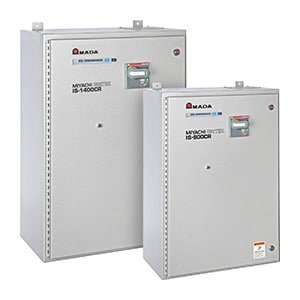
Features:
Benefits:
Typical Applications
and Uses:
| Spot Welding
Stainless and galvanized doors and
furniture
|
Seam Welding
Water filtration components
|
DC inverter power supplies offer
large
benefits in some resistance welding applications. Offered in capacities
of up to 325 kVA, dc inverter technology is able to deliver superior
weld quality by using lower weld currents, shorter weld times, and lower
weld forces than conventional AC controls. Through the use of a high speed
control monitoring multiple weld functions using adaptive feedback, the
user is able to regulate the welding process.
Superior control over current and
heat generation results in a reduction in energy use and increase in electrode
life, as well as improved weld quality, increased production efficiency,
and reduced cost.
Closed Loop Feedback Control
A closed loop feedback system means
that the control receives input as to how this particular weld is progressing
and adjusts to maintain the weld at the entered specification. The control
is able to maintain either weld current or power (user selected) by measuring
and adjusting the secondary current and voltage. The control gets new feedback
every 500 microseconds, consistent weld current (or power) at the electrodes
is maintained, overcoming power fluctuations and workpiece material variances
that hurt weld quality.

![]() |
Adds process security by displaying Current, Power, time and error data while inhibiting access to programming functions. |
To put together a complete system you need the following separate components:
Transformer Selection
Table
| Model | IT-40 | IT-85 | IT-130 | IT-250 |
| IS-120A (Spot) | XX | XX | ||
| IS-444B (Spot) | XX | XX | ||
| ISA-500A (Spot) | XX | |||
| IS-471B (Spot) | XX | XX | ||
| IS-443B (Seam) | XX | XX | ||
| IS-470B (Seam) | XX | XX |
| Power Supply Model | IS-120A | IS-444B | ISA-500A | IS-471B |
| Power Source: | 3 phase 480VAC / 440 VAC / 220VAC +10% -15% 50/60 Hz | |||
| Output Frequency: | 1 kHz / 800 Hz / 600 Hz (selectable) | |||
| Output Voltage: | Single Phase 650V, Peak at 480V input | |||
| Rated Capacity: | 52 kVA at 480 VAC | 182 kVA at 480 VAC | 325 kVA at 480 VAC | |
| Maximum Primary
Output Current: |
200 A (8% duty cycle) | 500 A (15% duty cycle) | 1000A (12% duty cycle) | |
| Control Systems: | Secondary Constant Current
Secondary Constant Power Primary Constant Current (RMS) Primary Constant Current (Peak) Fixed Pulse Secondary Constant Voltage |
Secondary Constant Current
Secondary Constant Power Primary Constant Current (RMS) Primary Constant Current (Peak) Fixed Pulse |
||
| Control Modes: | N/A | Forging, Chaining,
Successive |
N/A | |
| Weld Schedules: | 15 schedules | |||
| Timer Settings:
Squeeze Delay Squeeze Weld 1 Upslope Cool Weld 2 Downslope Hold Off Pulses |
ms Mode
0000-9999 ms 0000-9999 ms 000-600 ms 000-400 ms 000-999 ms 000-600 ms 000-400 ms 000-999 ms 0000-9999 ms 1-9 and Cycle Mode (see right) |
ms Mode
0000-9999 ms 0000-9999 ms 000-600 ms 000-400 ms 000-999 ms 000-600 ms 000-400 ms 000-999 ms 0000-9999 ms 1-9 |
Cycle Mode
000-999 cycles 000-999 cycles 00-30 cycles 00-20 cycles 00-99 cycles 00-30 cycles 00-20 cycles 00-99 cycles 00-99 cycles 1-9 |
|
| Maximum Secondary
Current Settings: |
0.1 -- 20.0 kA | 2.0 -- 40.0 kA | 4.0 -- 80.0 kA | |
| Weld Monitors:
Current Voltage Power Pulse Width |
00.0-20.0 kA 00.0-9.99 V 00.0-20.0 kW 10%-100% |
00.0-40.0 kA 00.0-9.99 V 00.0-40.0 kW 10%-100% |
00.0-80.0 kA 00.0-9.99 V 00.0-80.0 kW 10%-100% |
|
| Program Unit: | MA-627A (sold separately) | |||
| Monitor Unit: | MA-628A (sold separately) | |||
| Physical Characteristics: | ||||
|---|---|---|---|---|
| Dimensions:
H x W x D |
11 x 7 x 25 inches
(686 x 483 x 1600 mm) |
27 x 12 x 20 inches
(1702 x 762 x 1295 mm) |
27 x 12 x 26 inches
(1702 x 762 x1664 mm) |
|
| Weight: | 33 lbs.
(15 kg) |
99 lbs.
(45 kg) |
139 lbs.
(63 kg) |
|
| Power Supply Model | IS-433B | IS-470B |
| Power Source: | 3 phase 480 VAC / 440 VAC / 220 VAC +10% -15% 50/60 Hz | |
| Output Frequency: | 1 kHz / 800 Hz / 600 Hz (selectable) | |
| Output Voltage: | Single Phase 650V, Peak at 480V input | |
| Rated Capacity: | 182 kVA at 480 VAC | 325 kVA at 480 VAC |
| Maximum Primary
Output Current: |
500 A (15% duty cycle) | 1000 A (12% duty cycle) |
| Control Systems: | Primary Constant Current
(PWM RMS Value) Primary Constant Current (PWM Effective Peak) Fixed Pulse |
|
| Control Modes: | N/A | |
| Weld Schedules: | 7 schedules | |
| Timer Settings:
Squeeze Delay Squeeze Delay Weld 1 Upslope Cool Weld 2 Downslope Hold Off Pulses |
ms Mode
n/a 0000-9999 ms 000-999 ms 000-600 ms 000-400 ms (included in Weld 1) 000-999 ms n/a n/a 000-999 ms n/a 1-9 |
|
| Maximum Secondary
Current Settings: |
1.0 - 20.0 kA | 2.0 - 40.0 kA |
| Weld Monitors:
Current Pulse Width |
00.0-20 kA 10%-100% |
00.0-40 kA 10%-100% |
| Program Unit: | MA-627A (sold separately) | |
| Monitor Unit: | N/A | |
| Physical Characteristics | ||
|---|---|---|
| Dimensions:
H x W x D |
27 x 12 x 20 inches
(1702 x 762 x 1295 mm) |
27 x 12 x 26 inches
(1702 x 762 x 1664 mm) |
| Weight: | 99 lbs
(45 kg) |
139 lbs.
(63 kg) |
| Transformer Model | IT-40 | IT-85 | IT-130 | IT-250 |
| Rated Capacity: | 40 kVA at 50% | 85 kVA at 50% | 130 kVA at 50% | 250 kVA at 50% |
| Maximim Input Voltage: | 650 V | 650 V | 650 V | 650 V |
| Input Frequency: | 1000 Hz | 1000 Hz | 1000 Hz | 1000 Hz |
| Unloaded Secondary
Voltage/Turns Ratio |
4.28 V (152:1)
8.55 V (76:1) |
8.9 V (73:1)
9.5 V (68:1) |
13.0 V (50:1)
13.8 V (41:1) |
13.0 V (50:1) |
| Cooling Water | 1 gal/min | 2 gal/min | 4 gal/min | 4 gal/min |
| Dimensions:
H x W x D |
6.75 x 5.0 x 14.85 in
(432 x 330 x 965 mm) |
6.75 x 6 x 11.9 in
(432 x 381 x 762 mm) |
10.26 x 6 x 15.5 in
(660 x 381 x 991 mm) |
10.25 x 7.75 x 19 in
(660 x 483 x 1219 mm) |
| Weight: | 60 lbs.
(27 kg) |
60 lbs.
(27 kg) |
110 lbs.
(50 kg) |
130 lbs.
(59 kg) |
With quality and production demands
increasing, DC inverter resistance welding offers benefits that traditional
AC welding cannot address. In the broadest sense, inverter welding offers
more flexibility than conventional AC welding. Virtually any application
that can be done with an AC weld control can be done with inverter technology.
Inverter Performance Benefits
Many resistance weld failures can
be traced to inconsistent secondary welding current. Adaptive feedback
systems used in inverter technology utilize pulse width modulation to continuously
monitor and adjust the weld current throughout the weld, compensating for
non-uniform workpiece resistance, worn electrodes, and power source fluctuations,
resulting in extremely consistent weld current delivery throughout every
weld. The benefits derived include shorter weld times, lower currents and
forces, faster speed and throughput, longer electrode life, less weld splash,
and less surface deformation of the part.
Efficient Weld Current Delivery
Improves Quality
In resistance welding, a weld joint
(or nugget) is formed as weld current flows through the workpieces, encountering
different electrical resistanaces and generating heat. AC controls, by
definition, cycle weld current on and off twice per cycle. The AC "cycling"
can cause embrittlement and irregular nugget formation, hurting weld quality
and strength. By contrast, inverter systems deliver current without cycling,
thus continuously heating the weldments. Weld times can be adjusted in
one millisecond increments. This precise control allows inverter welders
to utilize shorter weld times and control how current can be introduced
into the parts by "shaping" the current weldform. Lower weld current and
less force (compared to AC weld controls) and be utilized to achieve the
desired molten state of the weldments for optimal nugget formation.
Hard to Weld Materials
Inverters are capable of successfully
welding a broad range of materials. Softer metals, particularly those with
high electrical and thermal conductivity are good candidates for inverter
resistance welding. Higher electrical conductivity means that higher weld
currents must be used. High thermal conductivity requires that the weld
current must be delivered quickly to minimize the heat affected zone. Zinc
coated galvanized steels also fall into this category.
High Current Output - Small
Transformer Package
Compact inverter equipment features
small, lightweight welding transformers for use in manual, automated, and
robotic (transgun) configurations. In AC resistance welding, higher current
outputs generally require extremely large transformers. The physical size
and weight of the AC welding transformer is especially critical in transgun
configurations, often limiting the current output available. Inverter transformers
are often as much as 50% smaller, lighter, and deliver higher current outputs
than conventional AC transguns.
Inverter Realities
Inverter performance benefits can
result in higher production rates with less time lost to electrode maintenance
and changes. According to many manufacturers, weld failures, part rejects,
and costly re-works have been dramatically reduced. Shorter weld times,
lower weld currents, and balanced line loads, lessen the primary current
demand - reducing electrical usage and expense. Adaptive feedback control
modes and millisecond programming make precise control over the resistance
welding process a reality. DC inverter welding allows for a broader process
window to overcome workpiece variances and production changes. This larger
process window is one of the primary reasons that inverter welding meets
today's demand for higher quality and delivers such an attractive return
on investment.
For more information, or help selecting
or pricing a DC Inverter system, feel free to contact
T. J. Snow. We will be glad to help in any way we can.
Other control options include:
Weld
Checker Chart | Other
Miyachi Products and Accessories
Welding
Supplies | Return to T. J. Snow
| Contact
Information: |
120 Nowlin Ln
P. O. Box 22847 Chattanooga, TN 37422 |
(423)
894-6234
1-800-NOW-SNOW FAX (423) 892-3889 ORDER FAX (423) 490-2417 |
| welders@tjsnow.com |